


Profiles received from our customers or drawings sent in DWG or PDF format are arranged in accordance with production presses and placed into diameters and shapes, then sent to the customer for approval.
Quality Control is a critical step in all stages of production to ensure that products comply with defined standards, technical drawings, and customer expectations. Quality control does not only involve checking the smoothness, functionality, and aesthetic quality of products, but also detecting errors, deviations, and deficiencies and ensuring their correction.
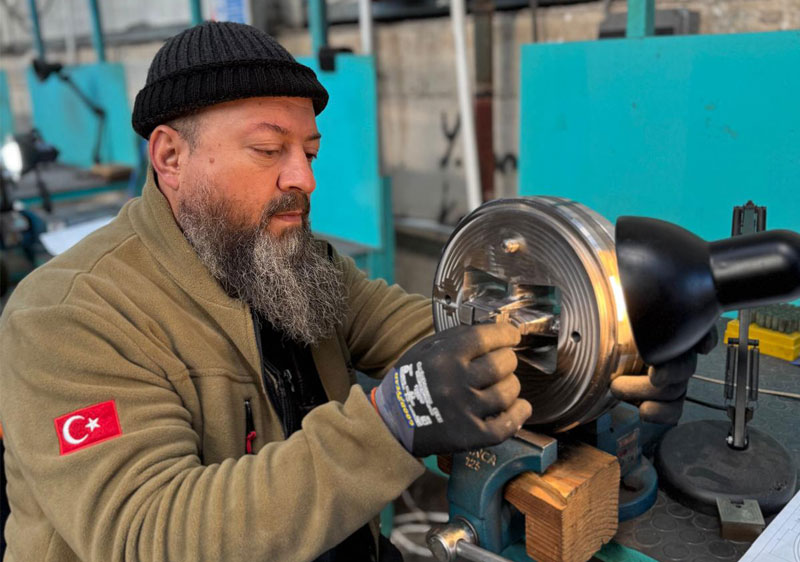
In our company, when molds enter production on presses, our highly knowledgeable, experienced, and technically skilled quality control team is activated to eliminate any possible issues in dimensions, angles, or surfaces. Our correction specialists intervene in the molds to ensure that the products reach an optimal condition and maintain the highest level of quality.
Quality Control Process
The quality control process consists of several stages, each carefully monitored to guarantee quality:
Initial Inspection and Measurement: At the beginning of production, an initial inspection is carried out to ensure conformity with the design of the mold or part. Comparative measurements are taken against technical drawings, and any deviation is corrected immediately.
Production Stage Control: During the production of the mold or part, all operations are continuously monitored. Various measurements and tests are performed to ensure that the product meets design requirements.
Functional Tests: The functional accuracy of the produced molds and parts is tested. Mold assembly and component compatibility are carefully checked to prevent any issues during assembly.
Surface and Visual Inspections: The surface quality of molds or parts is also inspected in terms of smoothness and aesthetics. Any roughness, scratches, deformations, or visual defects are corrected.
Final Test and Approval: After all production and testing stages are completed, the mold or part is reviewed one final time. Dimensions, angles, surface finish, and functionality are checked again. When all criteria are met, the product is ready for shipment.
Advantages of Quality Control
High Quality Assurance: Quality control processes ensure high quality in all aspects of the product, which is especially critical in precision mold and part manufacturing.
Early Detection of Errors: Continuous monitoring allows early detection and correction of production errors, preventing costly rework later.
Functional Reliability: The functional accuracy of molds and parts is verified to ensure proper operation and prevent potential issues in later stages.
Aesthetic Quality: Surface defects, scratches, and deformations are corrected to achieve flawless visual quality.
Customer Satisfaction: Delivering defect-free, high-quality products that fully meet customer expectations increases customer satisfaction.
Where is Quality Control Used?
Mold Production: Quality control is essential to ensure conformity with technical drawings and functional accuracy in mold manufacturing.
Precision Part Production: In high-tolerance manufacturing, quality control ensures perfection in all aspects of the product.
Why Us?
Experienced and Expert Team: Our quality control engineers and correction specialists carefully inspect each product and perform necessary adjustments.
Advanced Measurement Equipment: We use state-of-the-art measurement and testing devices to verify all quality criteria.
Working with Tight Tolerances: Even the smallest deviations in molds and parts are detected and corrected.
On-Time Delivery: Quality control processes ensure that products are delivered safely and on time.
Customer-Oriented Approach: We provide tailored solutions for each project to fully meet customer expectations.
With our quality control services, we achieve excellent results at every stage of production, delivering flawless, high-quality molds and parts manufactured to the highest standards.