


Profiles or drawings received from our customers in DWG or PDF format are arranged according to production press requirements in suitable diameters and shapes, and then sent to the customer for approval.
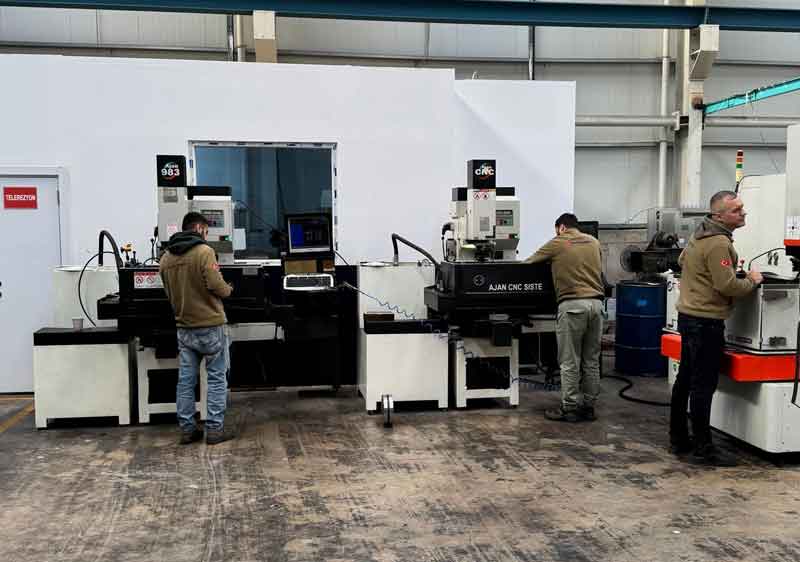
Arc (Sinker) EDM is a technology based on the principle of electrical discharge (spark erosion), used especially in precision part machining and mold manufacturing. This process allows material to be removed in a controlled manner by passing high-voltage electrical currents through the gap between an electrode and the workpiece. Sinker EDM is particularly used in machining complex shapes and fine details, achieving very tight tolerances, and it is also effective on hard materials. It is an important method for obtaining precise results.
In our company, sinker EDM machines are used especially for machining the backs of mold tongues, performing internal blasting operations (zıvana ara patlatmaları), and cavity removals using copper electrodes. These critical operations are carried out with high precision. Sinker EDM is ideal for production requirements involving difficult and complex processes.
Arc (Sinker) EDM Process Stages
Sinker EDM is carried out in specific steps:
Electrical Discharge Erosion: In sinker EDM, high-voltage electrical discharges occur between the copper electrode and the workpiece. These discharges erode the material surface and form the desired shape and depth. The process is used in machining complex geometries with very tight tolerances.
Mold Tongue Machining: In cases where mold tongues are weak, worn, or deformed, sinker EDM is used with copper electrodes to restore the backs of mold tongues to the proper standard. This process increases mold tongue durability and improves mold performance.
Internal Blasting and Cavity Removal: Sinker EDM machines are highly efficient for performing internal blasting and cavity removal operations. These processes are commonly used in mold manufacturing and other precision part production. Copper electrodes, due to their high electrical conductivity, perform these operations quickly and accurately.
Final Inspection and Tests: After the sinker EDM process is completed, the machined part is carefully inspected. Measurements are taken to verify whether the required tolerances are achieved. If any deviation is detected, the process can be repeated.
Advantages of Arc (Sinker) EDM
High Precision: Sinker EDM can machine with very tight tolerances. This allows complex shapes, fine details, and precise dimensional requirements to be achieved.
Machining of Hard Materials: Sinker EDM provides excellent results in machining high-hardness materials. This is a critical advantage especially when working with hardened steels.
Machining Complex Geometries: Sinker EDM is ideal for machining complex internal contours and details that are difficult to achieve with conventional methods.
Surface Quality: The EDM process produces high-quality surfaces. Surface roughness is minimized, and the need for finishing operations is reduced.
Minimal Heat Effect: During machining, the heat-affected zone is minimal. This eliminates the risk of deformation of the workpiece and helps maintain precise geometries.
Where Is Sinker EDM Used?
Mold Manufacturing: Sinker EDM is widely used for machining mold tongues, internal blasting, and cavity operations.
Precision Part Production: It is ideal for producing high-precision parts with tight tolerances. It is commonly used in automotive, aerospace, and machinery industries.
Hard Material Machining: Sinker EDM is highly effective in machining hardened steels and alloys.
Heat Treatment
Heat treatment is a set of controlled heating and cooling processes applied to improve the properties of metals and alloys. This process improves mechanical properties (hardness, durability, tensile strength, etc.) while also refining the material’s microstructure. It is especially important in molds, parts, and products requiring high durability.
Heat Treatment Processes
Heat treatment generally includes the following stages:
Heating (Preheating and Main Heating): The material is heated to a specific temperature. This temperature varies depending on the type of material being processed and the desired hardness level. For high-quality heat treatment, uniform heating of the material is ensured.
Cooling (Water Quenching, Oil Quenching, Air Cooling): The next stage of the heat treatment process is rapid cooling of the material. In this stage, the material is cooled at a specific rate to reach the desired hardness level. This cooling process can be performed using water, oil, or air depending on the material type.
Tempering (Softening): This process is applied to prevent brittleness in hardened materials. The material is held at a specific temperature and then cooled slowly. This process provides the required balance to the material.
46-48 HRC and 48-50 HRC Hardness Values
The molds and parts we process are treated to achieve hardness values of 46-48 HRC or 48-50 HRC. This hardness range provides durability, wear resistance, and long service life. The required hardness levels are determined according to the type of application and intended use of the material. Especially molds are exposed to high temperature and pressure, so such hardness values ensure long-term and reliable performance.
Why Heat Treatment?
Increased Durability and Wear Resistance: Heat treatment makes materials more resistant to wear. This is critical especially for continuously moving parts and molds.
High Hardness: High hardness ensures longer service life of materials and provides cost savings in production processes.
Improved Mechanical Properties: Heat treatment improves mechanical properties, enabling more reliable and durable parts.
Precise Process Control: Using German-made machines, all heat treatment processes are precisely controlled and high quality is achieved for each part.
Why Us?
High Quality Equipment: We achieve high efficiency and quality results with Germany-manufactured advanced heat treatment machines.
Expert Team: Our experienced engineers and technicians ensure proper process management at every stage.
Flexible Solutions: We provide customized heat treatment solutions according to different materials and hardness requirements.
On-Time Delivery: We deliver your projects on time with fast and efficient heat treatment processes.
With our Heat Treatment services, we make your molds and parts more durable, efficient, and long-lasting. We provide professional heat treatment solutions for all projects requiring high hardness, maximizing quality.
CNC Grinding
CNC grinding is a highly precise and efficient process used for machining surfaces that require high accuracy. CNC grinding machines, especially used to reduce surface roughness of molds and parts, ensure flatness and increase dimensional accuracy, play a critical role in modern manufacturing processes. This process provides excellent results in the final machining stages of molds and parts.
Our company uses CNC grinding machines to precisely machine the flatness, dimensions, and angular accuracy of molds and parts that have undergone heat treatment. Our high-quality grinding machines enable machining of surfaces with extremely tight tolerances.
CNC Grinding Processes
CNC grinding generally includes the following steps:
Preparation: First, the part to be ground is prepared for the grinding process. At this stage, the surface is checked for any residue or contamination.
Grinding Process: CNC grinding machines process the surface of the part very finely and precisely according to specified dimensions and flatness requirements.
Flatness Control: CNC grinding machines check the flatness, surface accuracy, and angular precision of the processed part.
Final Inspection and Tests: The finished parts are measured and inspected with high precision.
Advantages of CNC Grinding
High Precision: Provides micron-level accuracy.
Surface Smoothness: Significantly reduces surface roughness.
Repeatability: Ensures consistent results in mass production.
Complex Parts: Capable of processing complex geometries.
High Efficiency: Reduces production time.
Why CNC Grinding?
High Quality and Precision: Ensures flatness and dimensional accuracy of parts.
Long Product Life: Helps produce more durable components.
Time and Cost Advantage: Provides efficiency and reduces costs.
Flexible Solutions: Suitable for different material types.
Why Us?
State-of-the-art CNC grinding machines.
Experienced team.
0.001 mm precision.
Flexible production capacity.
On-time delivery.
With our CNC grinding services, your molds and parts are processed with high precision, ensuring surface smoothness and flatness.
It consists of a series of controlled heating and cooling processes applied to improve metals and alloys.