


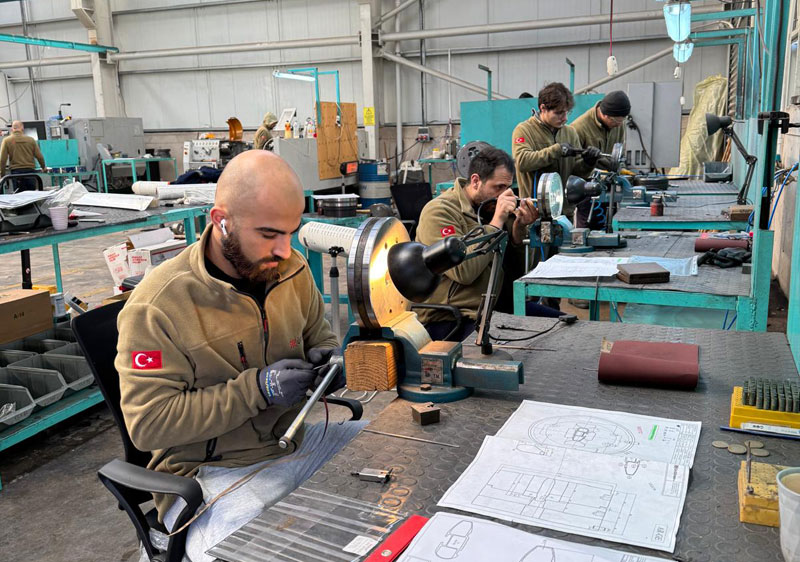
Profiles received from our customers or drawings sent in DWG or PDF format are arranged in accordance with production presses and placed into diameters and shapes, then sent to the customer for approval.
Fitting is a highly important process in the metalworking industry, especially in mold production and precision part manufacturing. This process is carried out to ensure surface smoothness of parts, achieve accurate dimensions, and guarantee proper assembly of components. Fitting is a critical step for correctly machining mold surfaces, surface angles, and transition areas.
Stages of the Fitting Process
The fitting process is generally carried out through the following steps:
Mold Transition Processing: Mold transitions are the cutting boundaries at the connection points of related surfaces within the mold. These transitions must be processed correctly and be smooth. The fitting process controls the smoothness of these transitions and fine adjustments are made when necessary.
Final Inspection and Testing: After the fitting process is completed, the mold is measured again. Dimensional tolerances and surface smoothness are checked. In addition, the mold’s suitability for assembly is tested. All these tests are necessary to ensure trouble-free mold assembly.
Advantages of Fitting
Smooth Surfaces: Surface smoothness is critical for producing high-quality and defect-free parts. Fitting removes surface roughness from mold surfaces and ensures a smooth finish.
Internal Geometry Compatibility: Transitions, angles, and connection points inside the mold are made compatible so that no misalignment occurs during assembly.
Improved Mold Performance: Proper mold smoothness reduces the risk of wear and deformation during production. Through fitting, mold performance is optimized and longer-lasting molds are achieved.
Ease of Assembly: Fitting ensures smooth assembly of the mold during installation. Proper alignment of parts increases production efficiency.
Where is Fitting Used?
Mold Production: Fitting is widely used to ensure smooth mold surfaces and angles and to correctly process transitions.
Precision Part Manufacturing: Fitting is necessary to ensure that precision-manufactured parts can be assembled properly.
High-Tolerance Manufacturing: In industries requiring high accuracy and quality, especially automotive, aerospace, and machinery sectors, fitting plays an important role.
Why Us?
Professional Team: Our experienced engineers and technicians guarantee quality at every stage and ensure correct execution of the fitting process.
Advanced Equipment: We use state-of-the-art fitting machines to perform high-precision operations on all types of molds and parts.
On-Time Delivery: Thanks to our efficient production processes, we deliver your projects on time.
With our fitting services, we ensure the smoothness, dimensional accuracy, and assembly compatibility of your molds and parts. From mold production to precision part machining processes, we guarantee high quality at every stage.